The Light at Grace Hill – Elle Christopher
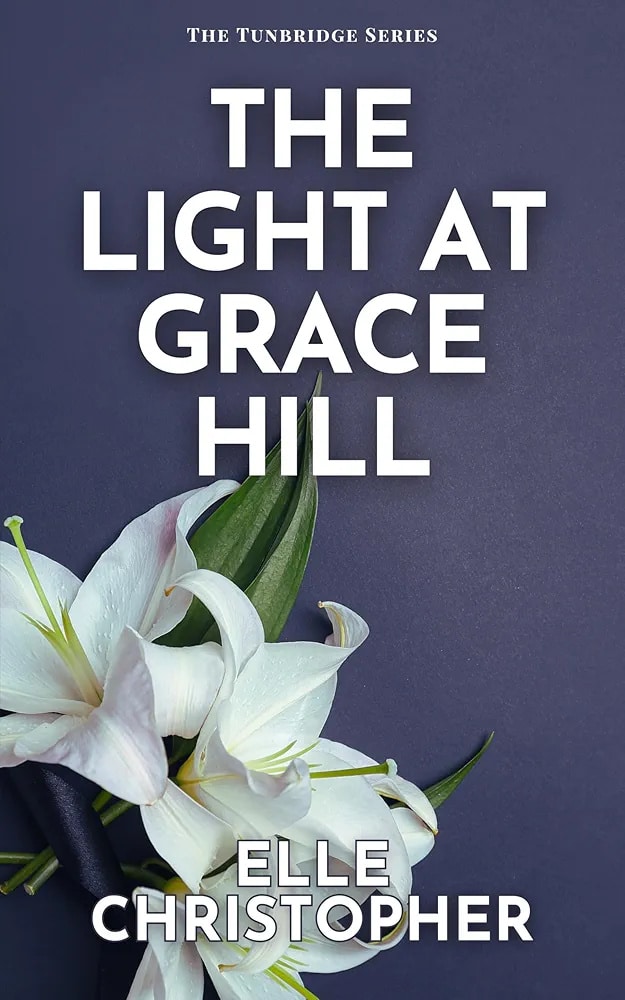
More Than a Love Story: Why The Light at Grace Hill Shines Brightest in Stillness
Life is hard. Sometimes truly horrific things happen, arriving without warning and leaving devastation in their wake. What ultimately defines a person, however, is not the trauma itself, but the choices made in its aftermath. The Light at Grace Hill explores this idea with quiet grace, following the story of Rose, a woman who has spent her entire life fixated on ‘the next thing’. She is always moving forward, always planning, never pausing long enough to reflect, until twisted metal and flashing lights force her to stop. In that moment of enforced stillness, Rose must decide whether this event will define her forever, or become a necessary course correction that leads her towards a fuller, more intentional life.
Although this is the third instalment in Elle Christopher’s Tunbridge Series, it stands out for how confidently it welcomes new readers. Too often, later books in a series rely heavily on prior knowledge, leaving newcomers feeling as though they have missed something essential. That is not the case here. Familiar faces from earlier books do appear, but they exist to enrich the setting rather than dominate it. Long-time readers will appreciate the added layers of history and emotional continuity. At the same time, those starting here are given fully realised, vibrant characters who make sense within the confines of this story alone. It is a delicate balance, and one Christopher handles with considerable skill, allowing the small-town world of Tunbridge to feel lived-in and expansive without ever becoming overwhelming.
Elle Christopher is not simply a writer; she is, quite clearly, an artist. She does not merely describe scenes; she paints with words. Her prose is rich and immersive, filled with sensory detail that pulls the reader directly into the heart of the story. You can see the light glittering as it dances across the rippling surface of the lake, feel the winter chill in the air, and almost smell the spiced sweetness drifting from the Christmas market stalls. This attention to atmosphere gives the novel an undeniably tender, almost ethereal quality. Every chapter is steeped in emotion, creating a reading experience that feels gentle, reflective, and quietly uplifting.
That same strength, however, also gives rise to the book’s one notable weakness. At times, Christopher relies a little too heavily on repeated phrasing. Certain expressions, most notably ‘the kind of’, appear with surprising frequency. On their own, these repetitions are minor, but when they occur multiple times on the same page, they can momentarily pull the reader out of the story. For those who simply want to sink into the beauty of the language and the mood it creates, this may barely register. For more detail-oriented readers, however, it may prove mildly distracting. It is not a flaw that undermines the novel as a whole, but it is worth noting.
At its core, The Light at Grace Hill is a slow-burning romance, and it is all the stronger for that restraint. The connection between the two central characters unfolds gradually, built on shared vulnerability, mutual respect, and emotional honesty. Both carry their own scars and unresolved pain, yet neither is reduced to their trauma. Watching them tentatively reach towards one another feels authentic and deeply human, avoiding the rushed intensity that often plagues romantic storylines. This is a love story, certainly, but it is equally a story of self-discovery, healing, and personal growth.
One of the novel’s greatest strengths is its portrayal of a strong female lead who does not lose herself for the sake of romance. Rose’s journey is firmly her own. Love becomes part of her life, not its sole purpose, and that distinction is refreshing. Too many stories still equate fulfilment with romantic sacrifice; The Light at Grace Hill resists that narrative, instead celebrating self-worth and independence. It is also a closed-door romance, free of explicit scenes, allowing emotion, connection, and meaningful interaction to drive the story forward. In that sense, it feels like a palate cleanser, proof that intimacy can be conveyed powerfully without relying on shock value or cliché.
Overall, The Light at Grace Hill is a beautiful, quietly compelling novel. It draws the reader in from the very first chapter and holds them there with its warmth, emotional depth, and richly drawn setting. The characters are flawed, relatable, and entirely human, navigating a world that is imperfect but recognisably real. In that imperfection, they find moments of light, connection, and hope. It is a story that lingers long after the final page, reminding us that sometimes being forced to stop is exactly what we need to find our way forward.
Buy Direct from the author

Buy from Amazon

See what others think on Goodreads

Informative article, just what I was looking for.